
- A national stakeholder workshop was held in February to advance legislation for the Solomon Islands' first Independent Electricity Regulator.
- Through GCIEP, UK experts from Ofgem are actively working with the government to design and operationalise the new regulatory body.
- The reform aims to reduce reliance on diesel, lower electricity tariffs and open the market to Independent Power Providers (IPPs).
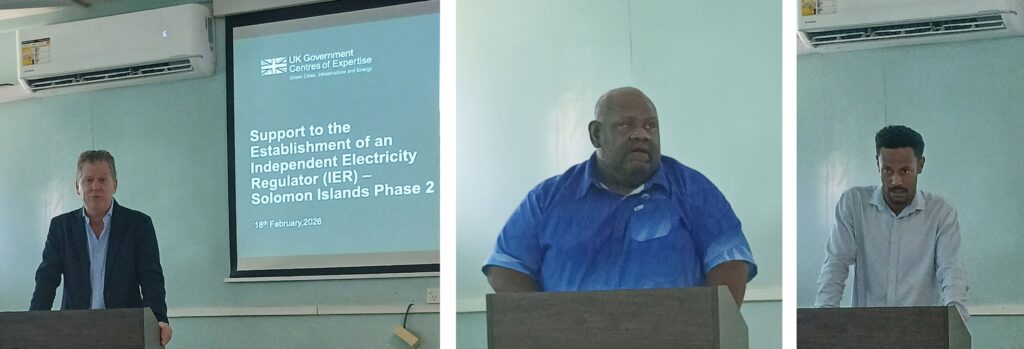
(L-R) High Commissioner Paul Robert Turner, MMERE Director Gabriel Aimaea and GCIEP National Team Lead William Kadi.
Government officials, utility operators and international development partners gathered in the Solomon Islands last month to advance the legislative framework for the country's first Independent Electricity Regulator.
Supported by the Green Cities, Infrastructure and Energy Programme (GCIEP), the establishment of this new regulatory body marks a critical step toward transforming an electricity sector currently burdened by some of the highest tariffs in the world.
Speaking at the national stakeholder workshop on energy reform, the UK’s High Commissioner to the Solomon Islands and Nauru, Paul Robert Turner, emphasised the urgency of overhauling the market. With roughly 90% of the current grid relying on expensive imported diesel, High Commissioner Turner described the system as economically and environmentally untenable.
He welcomed the government's vision for reform, noting that an independent regulator will break the current monopoly and create a level playing field for Independent Power Providers (IPPs) to enter the market. This increased competition is specifically designed to encourage private investment in off-grid and renewable energy, particularly solar power, to deliver cleaner and more affordable electricity.
The workshop served to canvas views on the draft legislation and ensure alignment among key sector actors. The discussions featured crucial inputs from Mr Gabriel Aimaea, Director of the Energy and Rural Electrification Division at Ministry of Mines, Energy and Rural Electrification (MMERE) and William Kadi, GCIEP National Team Lead. They were joined by representatives from the public utility, Solomon Power, alongside coordinated support from the donor-diplomatic community, including the World Bank and the Asian Development Bank.
To turn this policy ambition into reality, the UK government has deployed regulatory experts from Ofgem through GCIEP to assist MMERE. Having already conducted a comprehensive review of existing laws to identify gaps in governance and tariff setting, the GCIEP team is now providing critical transitional support.
This includes developing essential governance tools – such as interim tariff methodologies and generation license templates – so that the regulator can become fully operational the moment the new law is enacted.
By removing regulatory ambiguity today, GCIEP is helping the Solomon Islands signal stability to the market, a vital step toward achieving the government's goal of reducing electricity tariffs by 25% over the next three years and meeting its ambitious 2050 renewable energy targets.
The UK’s Green Cities, Infrastructure and Energy Programme is tackling climate change and extreme poverty by accelerating the delivery of sustainable green cities and climate-resilient infrastructure.
Published
19/03/26