
- GCIEP Alliance and Oxford Global Projects delivered a two-day capability-building workshop in Amman focused on megaproject risk management for Jordan’s National Conveyance Project.
- Over 20 officials from key Jordanian institutions participated in the training, including the National Conveyance Project Management Unit, Ministries of Finance, Investment and Planning, Aqaba Special Economic Zone Authority and Aqaba Development Corporation.
- Insights from the workshop will inform the finalisation of the design Risk Management Facility Framework to be completed by the end of March 2026.
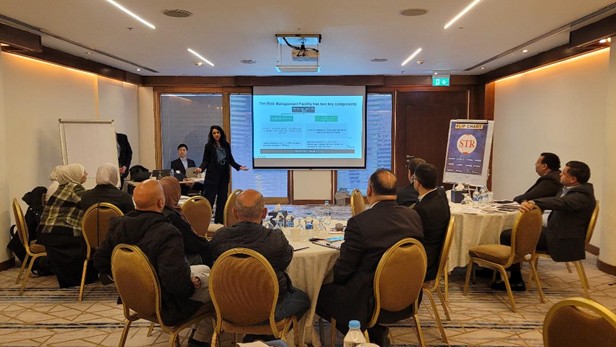
GCIEP delivers training on megaproject success and proactive risk management to senior leaders responsible for Jordan's National Conveyance Project.
The Green Cities, Infrastructure and Energy Programme (GCIEP) Alliance, in partnership with Oxford Global Projects (OGP), delivered a specialised capability-building workshop on megaproject risk management for Jordan’s National Conveyance Project (NCP) – a national desalination and water conveyance project. A central component of the workshop was a series of interactive project and programme risk identification exercises involving more than 20 government stakeholders. This is the first time OGP’s flagship and bespoke Reference Class Forecasting Tool has been presented to government officials through GCIEP.
For GCIEP, this activity directly supports programme outcomes by strengthening the implementation of the Risk Management Facility (RMF) and preparing stakeholders to engage effectively with NCP governance forums. More broadly, the training addresses the root causes of systemic megaproject failure, such as optimism bias and strategic misrepresentation, which historically lead to significant cost overruns and delays. By building capability for risk-informed decision-making and consistent interpretation of risk severity and escalation thresholds, this work significantly improves the likelihood of delivering Jordan’s largest water infrastructure project on time, within budget and with its intended benefits.
The workshop brought together more than 20 key decision-makers and senior leaders from across the Jordanian government. Participating institutions included the National Conveyance Project Management Unit (NCPMU) and Readiness Unit, Ministry of Investment, Ministry of Finance, Ministry of Planning and International Development, Aqaba Special Economic Zone Authority, and the Aqaba Development Corporation. The event also featured opening remarks from the NCPMU Director.
Megaprojects around the world often underperform because underlying risks are not adequately identified or managed. Decision-makers frequently underestimate costs and delivery timelines while overestimating potential benefits. Jordan’s NCP faces inherent scale and complexity risks. Given the increasing pressures of climate change and water scarcity,), it is critical to understand these risks early and establish clear thresholds for escalation and mitigation.
Through interactive risk identification exercises and the introduction of reference class forecasting – a method that uses data from comparable projects to counter internal biases –stakeholders were able to actively map out specific vulnerabilities and protect the NCP's delivery timeline and budget. More predictable and efficient delivery of this major climate adaptation infrastructure will enhance long-term water security vital for Jordan’s growing population. Reliable access to water is particularly important for low-income and vulnerable households, including women and persons with disabilities, who are disproportionately affected by water scarcity.
The risks identified and insights generated during the workshop will inform the development of the RMF Framework and support the RMF operating model. The GCIEP Alliance and OGP will build on these learnings and continue working closely with stakeholders to complete the design of the RMF Framework by the end of March 2026.
The UK’s Green Cities, Infrastructure and Energy Programme is tackling climate change and extreme poverty by accelerating the delivery of sustainable green cities and climate-resilient infrastructure.
Published
13/03/26