
- Strong demand for Better Business Case training was converted into greater impact through a second cohort, with a total of 35 officials trained.
- A shared methodology brought provincial departments, agencies and municipalities together around a common approach to infrastructure decision-making.
- Learning moved swiftly from the classroom into practice through hands-on support for a live, province-wide priority infrastructure project.
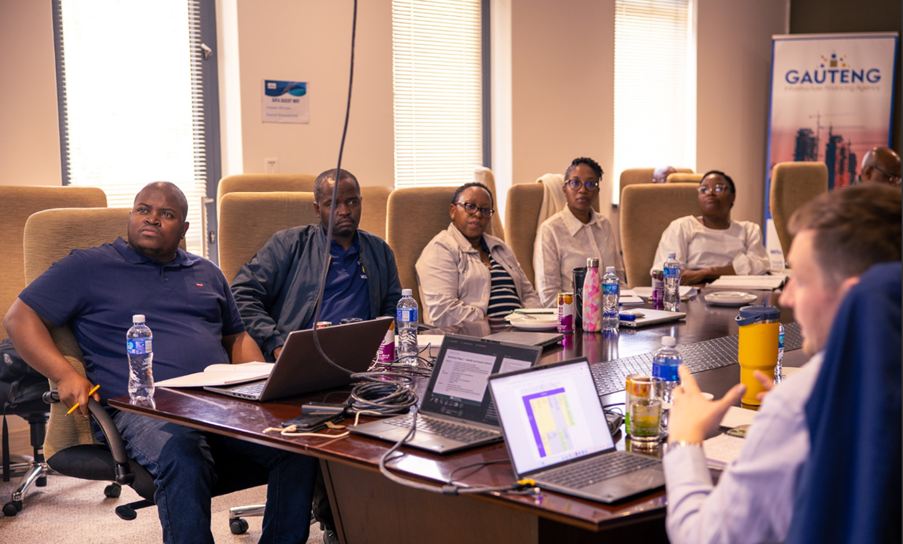
15 government officials were trained in the second cohort of Better Business Case training.
Building the capability to deliver complex infrastructure is as much about people and processes as it is about funding. In Gauteng, South Africa, the Green Cities, Infrastructure and Energy Programme (GCIEP) is addressing this challenge by equipping public sector teams with the tools, confidence and practical experience needed to plan and deliver projects that work for the province over the long term.
Following the successful delivery of Better Business Case training to 20 officials in September, demand from across the Gauteng Provincial Government created an opportunity to extend the training. Through careful planning and cost savings, a second cohort of 15 participants were trained, significantly expanding the reach and impact of the capacity building.
The four-day training, delivered at the Gauteng Infrastructure Financing Agency’s offices in Sandton between 25 and 28 November 2025, brought together professionals from the Gauteng Infrastructure Financing Agency, the provincial Department of the Environment, the Provincial Treasury and the Department of Cooperative Governance and Traditional Affairs. This mix of perspectives enriched discussion and helped build a common language for decision-making across institutional boundaries.
At the heart of the training sits the Five Case Model, a structured approach designed to improve how public investment decisions are made. For Gauteng, it plays a critical role in strengthening the province’s ability to shape and deliver a complex pipeline of infrastructure projects in the years ahead. The model aligns closely with wider work to establish a Programme Management Office within the Office of the Premier, supporting more consistent, transparent and effective project delivery across the government. Crucially, it ensures that climate risk and gender equality, disability and social inclusion considerations are embedded from the outset, rather than retrofitted later in the process.
The training also directly supports GCIEP’s ambition to improve the enabling environment for infrastructure investment. By sharpening planning, optioneering and analysis, the Five Case Model helps maximise public value while ensuring projects remain affordable and commercially viable, including those that may be delivered through public-private partnerships. The results speak for themselves, with 14 of the 15 participants in the second cohort passing the examination and securing the Better Business Case Foundation qualification. Across both cohorts, 35 officials completed the course, with 31 passes and a strong grounding in applying the methodology within the government.
Immediately after the training, targeted support began for the development of a business case for a live project. The team spans provincial departments and the municipalities of Johannesburg, Tshwane and Ekurhuleni, extending the benefits of capacity building well beyond the training room.
Following an initial scoping exercise, the project selected focuses on the development of a digital monitoring tool bringing together data on landfill capacity, waste routes and asset condition across the province. By improving coordination and visibility, the initiative has the potential to transform how waste management challenges are addressed in Gauteng, while giving public officials hands-on experience of developing robust, real-world business cases.
The UK’s Green Cities, Infrastructure and Energy Programme is tackling climate change and extreme poverty by accelerating the delivery of sustainable green cities and climate-resilient infrastructure.
Published
16/12/25