
- Senior provincial leadership aligned around a shared vision for integrated and sustainable infrastructure delivery across Gauteng.
- The role of the Provincial Programme Management Office was clarified as a high-performance coordination hub within the Office of the Premier.
- Real-world delivery barriers were discussed and translated into prioritised, practical actions, with cross-department collaboration strengthened to support measurable public value.
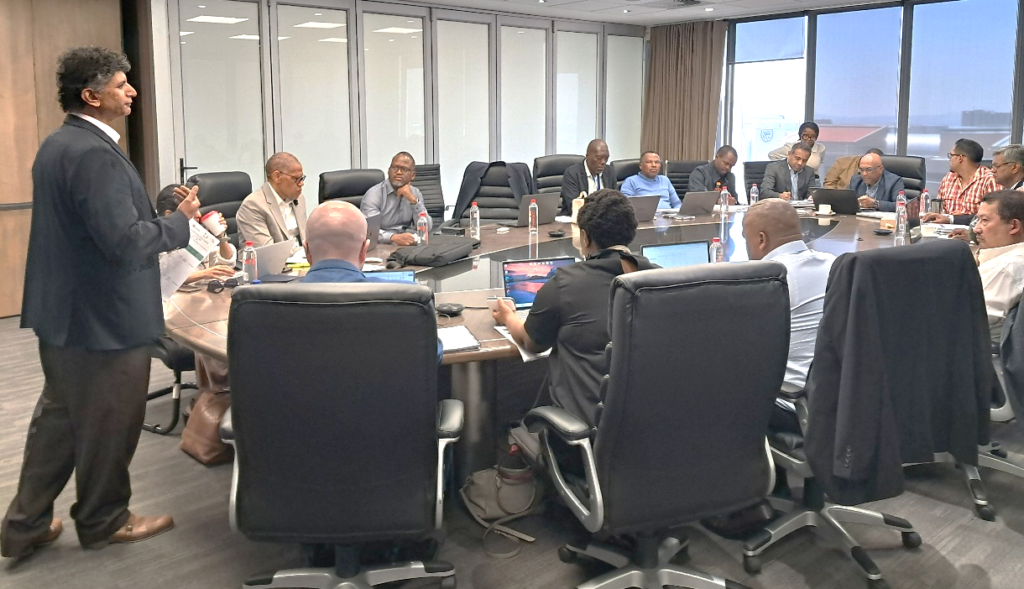
GCIEP's In-country Lead, Kribbs Moodley, facilitated the 2-day visioning and alignment workshop.
The Green Cities, Infrastructure and Energy Programme (GCIEP) convened a visioning and alignment workshop on 3 and 4 December 2025 in Johannesburg, marking a decisive moment for Gauteng’s infrastructure landscape. Senior leaders from across provincial departments, state-owned entities and strategic partners came together with a common objective – to move beyond fragmented delivery and establish a shared pathway for integrated, sustainable infrastructure development.
The tone was set early by the expectations of the Acting Deputy Director-General for Transformation. These expectations framed the Provincial Programme Management Office (PgMO) as a high-performance engine within the Office of the Premier, designed to bring order, consistency and transparency to a complex delivery environment. With this strategic anchor in place, discussions shifted quickly from aspiration to practical reform.
Across two days, participants worked through a carefully sequenced programme. The first day focused on shaping a collective vision and aligning priorities to deliver tangible impact. The second day turned that vision into action, examining how institutional arrangements, processes and capabilities must evolve to support delivery at scale. Long-standing challenges were addressed head-on, including fragmented governance, misaligned planning and budgeting, siloed implementation and limited capacity. Rather than treating these as abstract problems, participants explored their real consequences on project timelines, costs and public trust.
A defining moment of the workshop was the fishbowl session, which brought unfiltered perspectives to the centre of the room. In a dynamic, rotating format, participants spoke candidly about programme planning, expenditure management, reporting and accountability, cross-department coordination and capability gaps. The discussion revealed both pockets of good practice and recurring bottlenecks, creating a shared understanding of where change is most urgently needed.
The outcomes of the workshop reflected this depth of engagement. A unified vision for the PgMO was agreed, alongside guiding principles and a set of priority actions aimed at strengthening governance, improving coordination and enabling more predictable delivery. Collectively, these outcomes position the PgMO currently being established in the Office of the Premier as a focal point for collaboration, innovation and measurable impact.
The visioning and alignment workshop represented more than a planning exercise. It signalled a shift towards a more connected, accountable and delivery-focused approach to infrastructure in Gauteng. By aligning leadership around a clear vision and actionable priorities, the province has taken a meaningful step towards infrastructure that delivers lasting value for its people and its future.
The UK’s Green Cities, Infrastructure and Energy Programme is tackling climate change and extreme poverty by accelerating the delivery of sustainable green cities and climate-resilient infrastructure.
Published
22/12/25