
- GCIEP assessed the Lumbini Provincial Capital City Master Plan across seven areas, including economic viability, climate hazards, catalytic projects, partnership opportunities and institutional capacity.
- Advice to the government included optimising land use, identify priority catalytic projects and aligning spatial planning with realistic population and economic growth forecasts.
- The Lumbini Provincial Capital City holds strategic potential as a regional gateway and has the ingredients to become a climate-responsive, inclusive provincial capital.
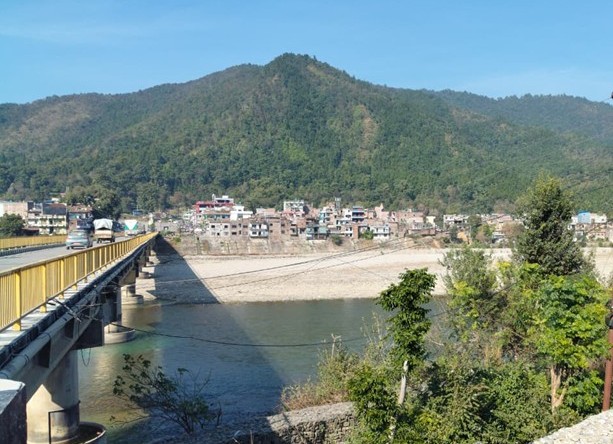
Lumbini Provincial Capital City.
Deukhuri Valley’s Bijauri was declared the provincial capital of Lumbini in 2020. The Lumbini Provincial Capital City (LPCC) Master Plan, prepared in 2022 for a 2051 horizon, sets out an ambitious vision for an economically vibrant, climate-resilient, environmentally sustainable and socially inclusive capital.
The Green Cities, Infrastructure and Energy Programme (GCIEP)’s review positions itself as a delivery-focused companion to the Master Plan, strengthening its credibility, bankability and ability to implement. Rather than revisiting the vision, it translates ambition into realistic, sequenced pathways aligned with government priorities and development finance institution expectations.
A central shift is reframing LPCC as a self-sustaining provincial growth hub. Located at the intersection of the East–West Highway, the Rapti River system and key north–south corridors, LPCC has the potential to coordinate and upgrade existing flows of agriculture, trade, labour and services across the Dang–Deukhuri system.
Growth is therefore treated as a market-led proposition. Population and spatial expansion must follow employment, institutional relocation and economic activation, rather than being assumed outcomes of capital city designation.
GCIEP assessed the Master Plan across seven workstreams, including spatial review, economic viability, climate hazards, catalytic project prioritisation and institutional capacity.
The review finds that the plan currently reflects political intent more than a fully articulated economic rationale. Population forecasts are absent, land use mixes remain unclear, and a uniform grid is overlaid onto complex terrain. This creates significant cost and delivery implications, including the need for around 148 bridges, many of them complex, with high capital and maintenance burdens.
Flood risk along the Rapti River emerges as the defining constraint. Significant exposure remains even with existing setbacks, while critical utilities are located in high-risk areas, creating avoidable operational and ecological risks.
The review reframes climate risk as a structuring principle. A climate-first approach directs early development to safer zones, with blue–green networks acting as core infrastructure for flood management, liveability and place identity.
Equally, LPCC’s success depends on disciplined sequencing. A compact, fully serviced Phase 1 core is identified as the starting point, supported by catalytic investments in connectivity, site-enabling infrastructure and economic stimulus projects. Growth is then unlocked through trigger-based expansion tied to real demand.
Despite current constraints, LPCC holds strong strategic potential. Cultural and tourism circuits, agricultural value chains and its role within a wider regional system position it as a credible economic node rather than a speculative new city.
Delivering this vision will depend on treating land, governance and institutional capacity as core infrastructure, ensuring equitable land pooling, strong development control and coordinated programme management.
Four key takeaways from the Master Plan review:
- Plan with purpose – Align spatial ambition with economic and demographic realism.
- Map flood risk as a first principle – Water systems define safe growth zones; fixed setbacks are insufficient.
- Prioritise sequencing and bankability – Phased, demand-led delivery underpins investment confidence.
- Leverage cultural and ecological assets – These are central to identity, competitiveness and long-term value.
Deukhuri has the foundations to become a climate-responsive and inclusive provincial capital. With disciplined sequencing, climate-informed planning and a market-oriented approach, LPCC can evolve into a resilient, investable city that strengthens the wider Lumbini economy.
The UK’s Green Cities, Infrastructure and Energy Programme is tackling climate change and extreme poverty by accelerating the delivery of sustainable green cities and climate-resilient infrastructure.
Published
31/03/26