
- GCIEP strengthened Zambia’s clean‑energy procurement by supporting government to design and implement a renewable‑energy procurement framework and deliver incentives, licensing reforms and capacity building to help the government run competitive tenders.
- GCIEP advanced Zambia’s Open Access reforms through market‑process mapping, risk‑allocation analysis and conceptualisation of the Public Service Trader, while supporting National Energy Policy updates to align with renewable energy, private‑sector participation and regional power‑market developments.
- GCIEP has unlocked transmission investment pathways by identifying priority grid projects, outlining viable financing models, producing investor‑facing materials and analysing regulatory gaps, positioning Zambia to mobilise private capital, strengthen grid reliability and support long-term power‑sector reforms.
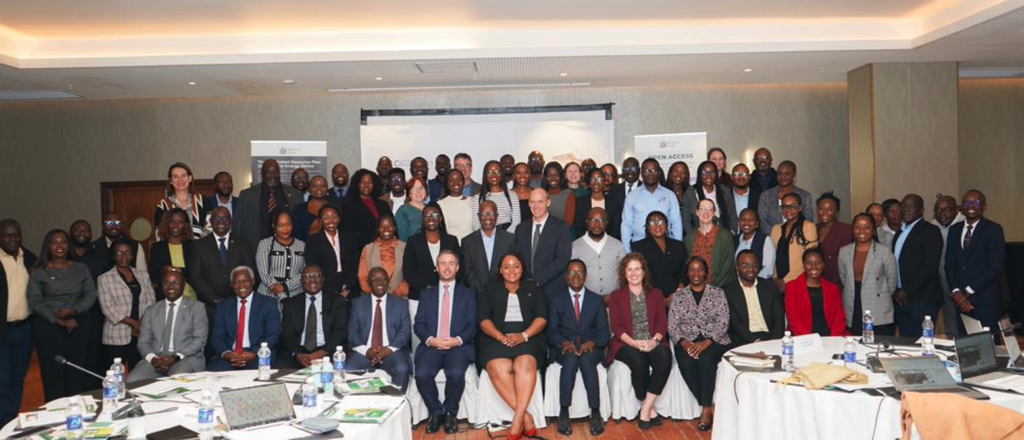
The GCIEP Zambia team with representatives from the Ministry of Energy and ZESCO
The GCIEP Zambia Closeout Reception took place on Wednesday, 10th June at the British High Commissioner’s (BHC) residence in Lusaka. The format was an evening reception comprising networking, formal presentations, a stakeholder engagement session, and a deliverables handover ceremony.
The event aimed to formally close out GCIEP’s energy sector support by presenting key workstream outputs, facilitating stakeholder dialogue, and handing over completed deliverables to Government of the Republic of Zambia (GRZ) institutions. The event brought together senior representatives from the Ministry of Energy (MoE) Office for Promoting Private Power Investment (OPPPI), Department of Energy (DoE), Zambia Electricity Supply Corporation (ZESCO) and the Energy Regulation Board (ERB). Development partners and stakeholders included the African Development Bank (AfDB), International Growth Centre (IGC). GCIEP is also working closely with the FCDO Cities and Infrastructure for Growth Zambia (CIG Zambia), to ensure policy and technical assistance continuity.
GCIEP’s Zambia public procurement intervention strengthened the Government of Zambia’s ability to mobilise finance for new power projects by designing a robust, centralised renewable energy procurement framework and advancing preparations for a fast‑track solar tender. The programme completed draft RfP documentation, which was accepted by the Ministry of Energy (MoE) and produced a handover package for IFC to support tender launch. GCIEP also delivered a roadmap for a future procurement entity, an endorsed tax and non‑tax incentive framework, and enhancements to the Energy Single Licensing System, including a full training manual for the National Heritage Conservation Commission (NHCC). A major achievement was securing Cabinet approval for Zambia’s competitive procurement framework.
GCIEP has also supported GRZ to operationalise a financially sustainable Open Access electricity market and strengthen evidence-based energy policymaking. The programme modelled open access penetration to 2035, assessing stakeholder interest and ZESCO’s supply–demand dynamics, and produced a market process map that “identified gaps and ambiguities in the market processes” to inform future guidelines. GCIEP also developed risk‑allocation analysis for existing contracts and OA regulations, enabling ZESCO to understand and mitigate contractual risks.
A major achievement was conceptualising the Public Service Trader (PST), outlining governance scenarios and commercial roles to support Zambia’s liberalised market and ensure continuity of public procurement. Additional options papers clarified issues such as credit risk, inadvertent energy charges and PST cost recovery, feeding into updated market process guidelines. In parallel, GCIEP supported the review of the National Energy Policy, aligning it with renewable energy ambitions, open access reforms, private‑sector participation and regional power‑market developments.
GCIEP’s transmission intervention supported GRZ to unlock investment in grid infrastructure by addressing long‑term planning, financing and climate‑resilience challenges that constrain new generation and demand growth, particularly in the Copperbelt, North‑Western Province and the DRC export corridor. The programme produced an investor‑facing risk and opportunity assessment highlighting improvements in ZESCO’s financial sustainability, and delivered a Priority Transmission Development Report, updating the IRP’s phased plan using the latest Zambia–DRC demand data. GCIEP also prepared a Transmission Financing Report, outlining four financing models applicable to Zambia and presenting them to a multi‑stakeholder group.
Most recently, GCIEP matched financing models to ZESCO‑identified priority projects, developing a stakeholder map, regulatory gap analysis and high‑level funding memoranda, including capital costs, tariff requirements and investor return profiles. Engagement with commercial investors, DFIs and utilities provided feedback on bankability and implementation pathways.
Together, these achievements position Zambia to mobilise private capital, strengthen transmission reliability and support wider power‑sector reforms.
Well done to our excellent team in Zambia!
Published
22/06/26