
- GCIEP and the British High Commission in Accra hosted a high‑profile handover event on 14 May 2026, to celebrate two and a half years of partnership‑driven achievements.
- GCIEP has strengthened Ghana’s capacity to plan and finance climate‑resilient urban and energy projects, delivering feasibility studies that unlocked major commitments, including £12m from DANIDA, an £87m commitment from the European Union (EU) and European Investment Bank (EIB) for roads and drainage, and £14m EIB funding for sanitation.
- GCIEP’s support in establishing the Climate Finance Facility (CFF) within the Development Bank of Ghana (DBG) will help to mobilise a much greater scale of concessional and private capital for low‑carbon, climate-resilient infrastructure.
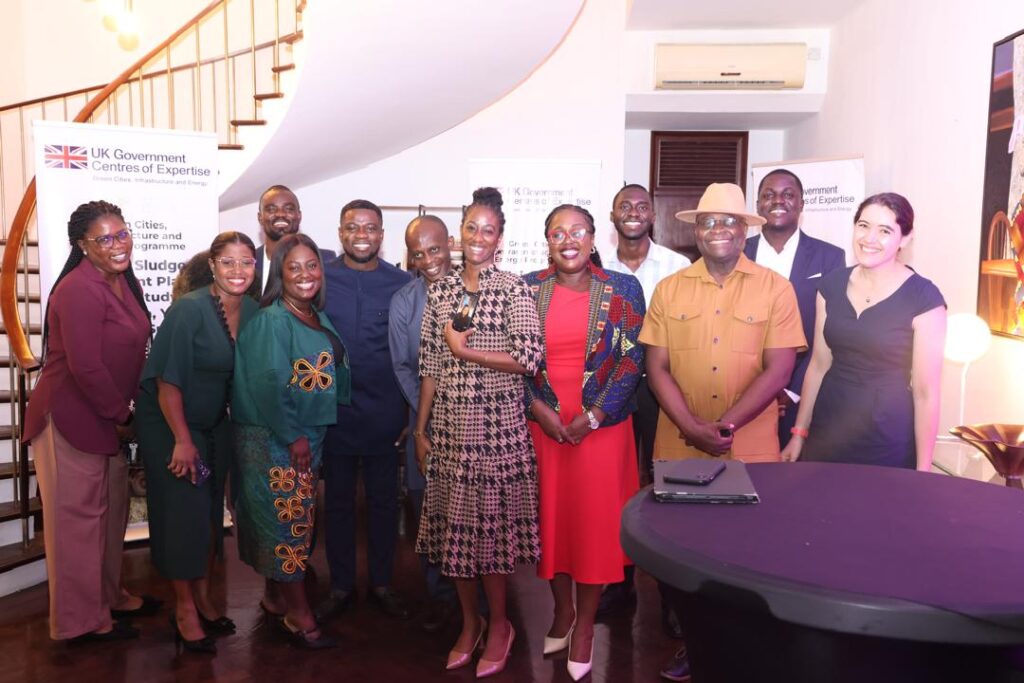
Members of the GCIEP Ghana team at the handover event in the British High Commission in Accra
To celebrate GCIEP’s achievements in Ghana and maximise partner commitment to continued implementation of activities, the GCIEP Ghana team collaborated with FCDO Post in Accra to organise the GCIEP handover event at the residence of the British High Commissioner on 14 May, hosting a wide range of Government of Ghana partners and many other stakeholders. The British High Commissioner, in his speech, highlighted GCIEP's achievements over the last two and a half years, based on strong partnerships grounded in mutual respect, shared priorities, and a commitment to long-term outcomes.
GCIEP’s urban development intervention in Ghana has significantly strengthened government capacity of counterparts that include Sekondi-Takoradi Metropolitan Assembly (STMA), Ghana Water Limited, the Ghana Hydrological Authority, the Department of Urban Roads, and the Ministry of Local Government while mobilising substantial climate-resilient investment. The initiative prepared investment-ready feasibility studies that unlocked major financing commitments, including a £12 million DANIDA grant for the Wa water distribution network, secured EU/EIB commercial interest of £87 million for mobility and drainage improvements in Sekondi‑Takoradi and mobilised £14 million from the EIB for faecal sludge treatment plants in five northern cities, committed for disbursement during 2026.
GCIEP also co-developed and operationalised a Climate Multi-Hazard Dashboard for 25 local assemblies (MMDAs), embedding climate risk into local planning. At the national level, the programme supported the approval of the Urban Policy Monitoring & Evaluation Plan.
GCIEP Ghana’s climate‑finance intervention has played a pivotal role in building the country’s institutional capability to mobilise concessional and private capital for low‑carbon, climate-resilient investment. A major achievement was the development of the Climate Finance Facility (CFF) within the Development Bank Ghana (DBG). The programme secured strong institutional buy-in through structured interviews, feedback sessions and board‑level presentations. This has resulted in active interest from key international climate finance institutions, including the EIB, European Bank for Reconstruction and Development (EBRD), Convergence, African Development Bank (AfDB) and the Global Environment Facility (GEF). The EIB has already drafted a scope of work aligned with the CFF’s next steps. The programme also completed the handover of the management of this Project Preparation Facility to FSD Africa and has developed a detailed pipeline of 14 climate aligned projects, including the Akosombo floating solar project, which GCIEP has supported under the energy intervention.
In the energy sector, GCIEP has advanced the 200 MW Akosombo–Sedom floating solar project on Lake Volta, the world's largest manmade lake, toward investment readiness while strengthening national capacity for variable renewable energy development. The programme delivered an enhanced pre‑feasibility study approved by the Volta River Authority (VRA), including assessments of “navigational safety, fisheries interactions, community interfaces, and grid integration constraints” and early bathymetric data collection, reducing technical uncertainty and enabling informed site selection. To mobilise finance, the programme co‑created investor-facing materials with VRA, including a pitch deck and Project Information Memorandum. Early market sounding generated positive interest from AfDB, AFD, the EU, and FSD Africa. These achievements have strengthened Ghana’s evidence base, improved engineering readiness, and positioned the project for future uptake by development finance institutions.
This builds on GCIEP’s earlier work in Ghana, to deliver intensive capacity building to the national grid operator, GRIDCo, enabling its staff to independently develop pre-feasibility studies for renewable energy. GCIEP also supported the establishment of a variable renewable energy (VRE) technical committee to help drive the clean energy transition.
Back at the handover event at the High Commission, many stakeholders spoke highly of the programme and highlighted the need for further collaboration with the FCDO to progress the projects into implementation.
Well done to our brilliant Ghana team!
Published
21/06/26