
- GCIEP has co-developed a Monitoring and Evaluation framework for the Just Energy Transition Partnership (JETP) in Senegal, supporting the country’s ambition of achieving universal energy access whilst transitioning to a low-carbon, and climate resilient energy system
- Working closely with the Senegalese Ministry of Energy, the project has engaged with local JETP working groups, donor representatives and other JETP country teams to develop a framework that is grounded in Senegal’s local context.
- Having delivered capacity building to the JETP Unit in Dakar, the M&E system will now be hosted and deployed locally to track progress and results across the JETP programme.
The JETP is an innovative, multilateral facility that supports countries in transitioning away from fossil fuels and advancing a low-carbon energy pathway that promotes inclusive growth. In June 2023, Senegal and the International Partner Group – including the United Kingdom, France, Germany, Canada and the European Union – launched the JETP to help deliver a more inclusive, resilient and sustainable energy system.
In Senegal’s context, this involves achieving universal access to electricity and increasing the share of renewables in installed generation capacity to 40% of the national electricity mix by 2030. These ambitions are central to Senegal’s sustainable development trajectory: whilst renewables currently account for around 32% of the energy mix, the country has recently become an oil and gas producer, creating risks of increased fossil fuel dependence. At the same time, nearly 30% of rural communities still lack reliable access to electricity, highlighting the need for a transition that is inclusive and equitable.
In operationalising the JETP, the British Embassy in Dakar, in consultation with the Senegalese JETP Unit and the International Partner Group, identified the need for a robust results framework and an accompanying digital tool to systematically track progress. In response, support was mobilised through GCIEP to co-develop
a Monitoring and Evaluation (M&E) system with the Senegalese JETP Unit. The framework comprises 32 indicators covering outcomes such as greenhouse gas emission reductions, renewable energy capacity additions, job creation and improved energy access for vulnerable populations under JETP-supported projects. A web-based platform enables the JETP Unit to input, manage and visualise programme data, including through an interactive public dashboard.
The project has been grounded in a co-development approach, with close collaboration between GCIEP, the British Embassy in Dakar and the JETP Unit throughout implementation, alongside key partners including IPG members, peer JETP countries such as South Africa and Indonesia and JETP Working Groups in Senegal. These focus on finance, policy and governance, justice and equity, and technology – bringing together Senegalese stakeholders in the energy sector such as public agencies, other ministries (agriculture, economy, finance, environment) and civil society, think tanks & research institutions. An initial co-design workshop to shape the indicator framework, followed by iterative consultations and feedback loops, ensured that the system reflects local priorities, secures buy-in from technical and financial partners, and draws on cross-country learning.
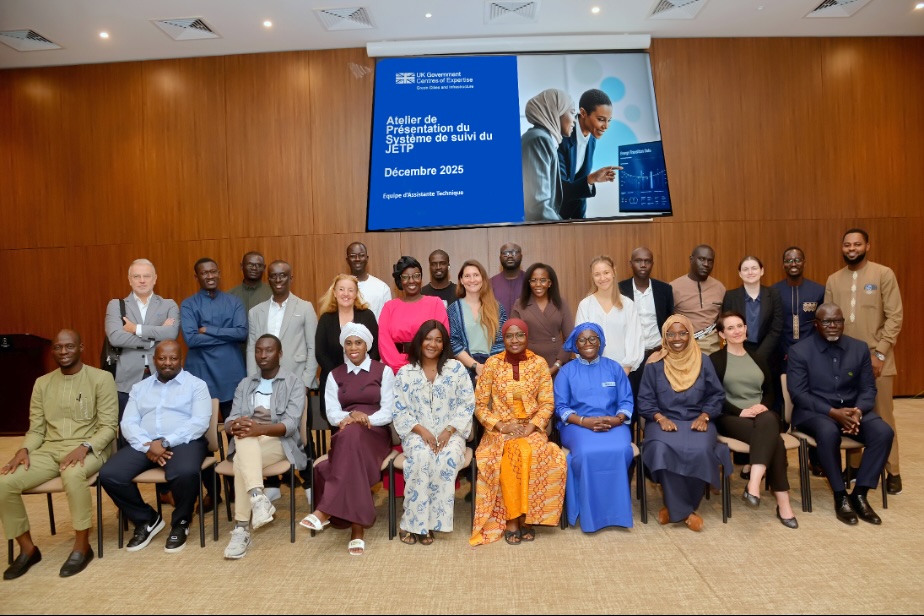
In December, a second in-person workshop was delivered to the JETP unit, IPG members, and working group members to introduce the web application developed under the GCIEP programme. Capacity-building activities were conducted alongside the workshop, focusing on training a core group within the JETP coordination unit — including the Director of Energy Transition and members with monitoring and evaluation
(M&E) responsibilities — on how to use the web application. This included guidance on collecting, inputting, and displaying monitoring data from JETP projects.
To enable a sustainable uptake, the system will be locally hosted by the Government of Senegal, and GCIEP has delivered targeted training sessions to strengthen the JETP Unit’s ability to manage and use the framework and digital platform. As a result, the JETP Unit will be equipped to provide the Government of Senegal and the IPG with regular reporting on progress towards JETP targets. This includes monitoring across environmental, economic and social dimensions, ensuring that Senegal’s JETP programme delivers positive climate outcomes, drives energy access and opportunity for youth, women and currently underserved communities, and creates the conditions for sustainable economic growth
Published
09/04/26