
By Leslie Detwiler, Zambia's Communications Expert, and Brian Mwanza, Public Procurement Lead at GCIEP.
A nation at an energy crossroads
Zambia has a clear opportunity to reshape its energy future through more effective procurement of new power generation. With the right systems in place, the country can unlock investment, reduce costs and accelerate delivery at scale. The country faces a significant power deficit that constrains economic growth, limits public services and holds back the livelihoods of millions of people. Addressing this deficit is not simply a technical challenge – it is a development imperative. The Government of Zambia has set ambitious targets through its Integrated Resource Plan (IRP) and Energy Compact (M300), signalling a clear commitment to expanding and diversifying the country's energy supply.
Achieving these targets, however, requires more than political will. It demands robust systems and the confidence of private investors who can bring the capital and expertise needed to develop new power projects at scale. Yet several deep-rooted barriers have made this a challenge. Zambia has historically lacked a unified, competitive and transparent procurement process for selecting, contracting and financing new power generation projects. As a result, projects that do come online are procured at a high cost. This is compounded by a fragmented institutional framework, with no dedicated entity responsible for power procurement, creating a persistent disconnect between Zambia's policy ambitions and its procurement processes. Meanwhile, Zambia’s national power utility, ZESCO, has limited creditworthiness, combined with the absence of sovereign guarantees following Zambia's debt default. means that strong off-taker risk mitigation measures are essential to attract private investment.
This is why the approval by the Zambian Cabinet of a new coordinated procurement framework in December 2025 – developed with the Green Cities, Infrastructure and Energy Programme (GCIEP) – marks a significant milestone. For the first time, Zambia has a structured, government-endorsed basis for running competitive energy tenders.
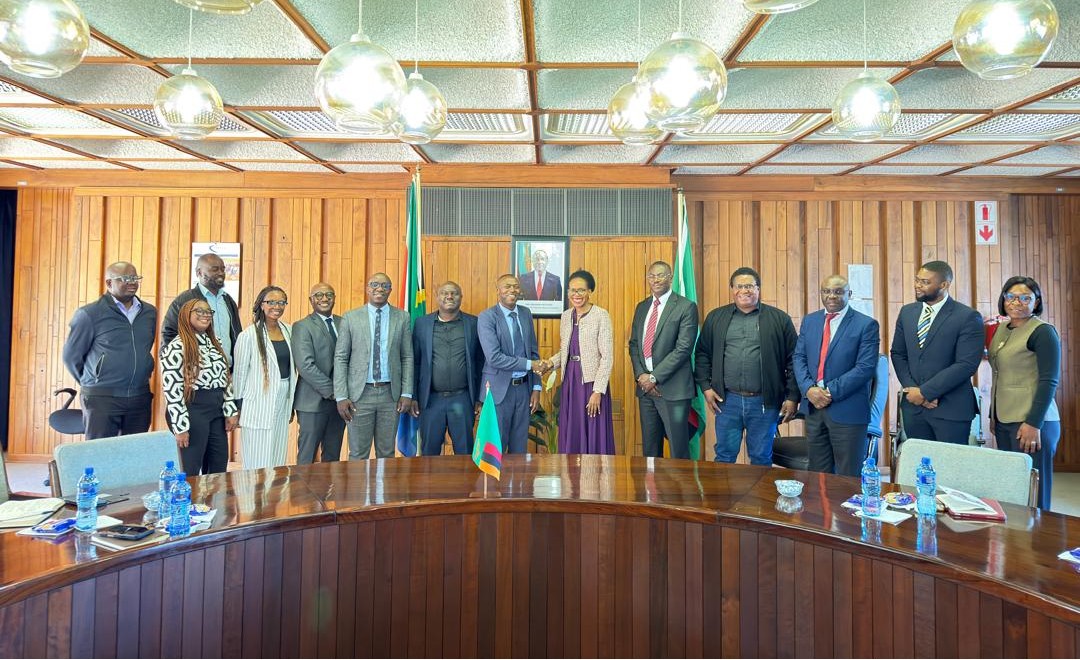
GCIEP's study tour to South Africa's Ministry of Energy for Zambia's Technical Working Committee.
How GCIEP is putting the framework into action
GCIEP's work to implement the framework is organised around two closely linked areas of work. The first focuses on supporting the finalisation of a 300–400 MW fast-track solar photovoltaics (PV) tender to address Zambia's near-term energy needs and demonstrate that competitive procurement can work in practice. Building on GCIEP's prior work, and aligned with the IRP and M300, this tender is designed as a pilot for a competitive, transparent and repeatable procurement process – one that embeds best-practice principles, incorporates gender, equality, disability and social inclusion (GEDSI) considerations into project scoring and tests credit enhancement mechanisms. If it succeeds, it establishes a template that can be replicated across future rounds.
Central to the request for proposals' (RfP) viability is the Renewable Energy Liquidity Mechanism (RELM). It provides the financial backstop that makes energy projects bankable, giving private developers and lenders confidence that they will be paid even if off-takers face short-term liquidity pressures. Designing it has involved a wide range of local and international parties, and reaching consensus has taken considerable time. GCIEP is actively facilitating engagements with cooperating partners to secure the funding commitments needed to make the RELM operational – without which the framework will remain on paper, rather than delivering impact.
The second work area takes a longer view, focusing on institutionalising the framework so that the government can independently lead and scale future tenders with less reliance on donor support. This includes submitting recommendations to the Ministry of Energy on the institutional structure for energy procurement and advising on the establishment of a dedicated procurement office within the ministry. To complement both work areas, GCIEP organised a study tour to South Africa's Ministry of Energy for members of Zambia's Technical Working Committee – offering direct exposure to learn from one of the continent's most successful competitive energy procurement programmes.
Building a legacy beyond the programme
The first solar tender is expected to launch following GCIEP's support, meaning the work being carried out now is fundamental to build systems and relationships that will outlast programme involvement. GCIEP is assisting the Ministry of Energy to identify project implementation partners who can facilitate the launch of the first tender and subsequent rounds, while preparing a suite of documents that the ministry and partners can draw on independently. By embedding this work within a broader network of cooperating partners, GCIEP is helping ensure the RELM is adequately funded, and the first competitive solar tender can be successfully launched.
The cabinet-approved framework is more than a procedural achievement. It represents a fundamental shift in Zambia's approach to energy development – from costly, ad hoc arrangements to a transparent, competitive process that can attract quality investment, drive down costs and deliver the power that Zambia's economy and people urgently need. With the IRP and M300 targets on the horizon, getting procurement right will not only unlock investment but also deliver reliable, affordable power that underpins economic growth and improves everyday life across Zambia.
The UK’s Green Cities, Infrastructure and Energy Programme is tackling climate change and extreme poverty by accelerating the delivery of sustainable green cities and climate-resilient infrastructure.
Published
09/04/26