
- Over 50 international and local stakeholders gathered to explore investment opportunities in Pemba.
- The African Development Bank’s Urban Development and Municipal Fund committed US$500,000 to advance the Green Bypass Road project.
- GCIEP-supported urban planning enabled Pemba to enter the African Cities Programme directly into project preparation – a rare achievement.
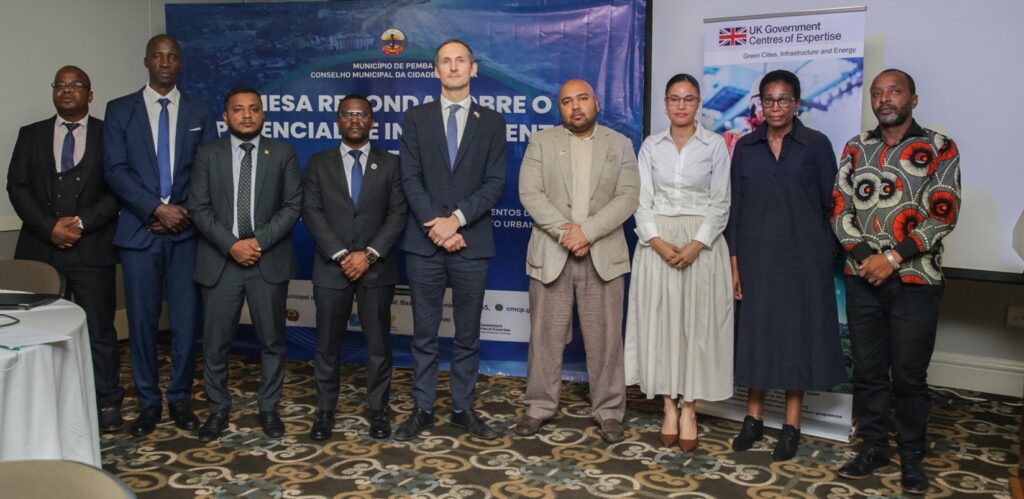
The Municipal Council of Pemba, GCIEP and FCDO convene to discuss investment opportunities.
On 12 March 2026, a roundtable on the investment potential in the City of Pemba was held at the Southern Sun Hotel in Maputo. The event was organised by the Municipality of Pemba with the support of the Green Cities, Infrastructure and Energy Programme (GCIEP).
The roundtable brought together more than 50 participants, including representatives from international organisations, development partners, commercial banks, embassies, public institutions and private sector companies. Among the institutions represented were the African Development Bank, the European Union, the Japan International Cooperation Agency (JICA), the UN Food and Agriculture Organisation (FAO) and other partners with a strong investment interest in the city of Pemba.
The opening session was delivered by the Mayor of Pemba, Satar Abdulgani, who acknowledged and expressed appreciation to GCIEP and the UK Government for their technical assistance in promoting initiatives aimed at sustainable urban development in the city. In his remarks, the mayor highlighted the event as an important platform to bring together investors, partners and institutions, strengthen trust-based relationships and explore pathways to transform Pemba’s potential into real opportunities for growth and prosperity.
For more than two years, GCIEP has strategically collaborated with the Municipality of Pemba to develop a strong project pipeline based on the city’s Urban Structure Plan (USP) and improve the enabling environment through improving creditworthiness, public finances and investment management.
Here is a summary video from the event.
The results came together in a well-attended investor roundtable discussion where the Urban Development and Municipal Fund (UMDF) of the African Development Bank made the biggest commitment, announcing that their board had chosen to support a project proposal by the municipality. Pending terms of reference and a support letter from the government, the UMDF will provide half a million US dollars (Around £375,000) to take the green bypass road project from pre-feasibility through to appraisal. In the process, Pemba received board accolades and also skipped a phase, straight to the project preparation facility, as part of the African Cities Programme, due to the quality of the proposal, environmental reform path and GCIEP-supported urban planning.
Other outcomes included UN-Habitat expressing willingness to provide technical support for an in-depth study on resettlement related to the bypass green road project; ENABEL indicated they would support through a results-based grant window, initially focused on the sanitary landfill operation; FAO demonstrated significant interest in the sanitary landfill project, already assessing the municipality’s needs for implementation; JICA expressed interest to explore the bypass green road project; Grindrod aim to explore urgent options to improve traffic flow and access to the city’s port; and the Roads Fund expressed its support for the Bypass Green Road project, contributing its expertise to help define sustainable business models.
The municipality presented the pre-feasibility project, detailing green mobility, waste management and urban sustainable drainage systems, all aligned to the USP focus areas. GCIEP’s institutional strengthening was showcased through presentations on USP development, neighbourhood plans and project pipelines, as well as reforms underway to strengthen Pemba’s creditworthiness, medium-term fiscal planning and asset management.
The representative of the British High Commission in Mozambique, Dominic Ashton, also emphasised the importance of the initiative for sustainable urban development. Noting the need for various stakeholder collaboration to achieve USP objectives, not only through financial resources but also through the sharing of technical knowledge needed to deliver development goals.
As a next step, the municipality, with GCIEP, will continue engaging stakeholders through bilateral meetings with partners and investors to further explore opportunities and gather more information on potential investments that can support the sustainable development of the city of Pemba.
The UK’s Green Cities, Infrastructure and Energy Programme is tackling climate change and extreme poverty by accelerating the delivery of sustainable green cities and climate-resilient infrastructure.
Published
09/04/26