
Author: Edom Woldegiorgis, GCIEP's Connecting Secondary Cities Coordinator.
As Ethiopia accelerates its economic transformation, attention is increasingly turning towards the role of secondary cities in driving trade, industrialisation and regional integration. Among them, Dire Dawa stands out as a city with exceptional potential. Strategically located along Ethiopia’s Eastern Economic Corridor, Dire Dawa sits at the intersection of critical logistics infrastructure: a Free Trade Zone (FTZ), a dry port, a railway station and a growing industrial park. Together, this infrastructure creates a powerful foundation for the city to evolve into a multimodal logistics hub connecting domestic production with regional and global markets.
Yet unlocking this opportunity requires more than infrastructure alone. It requires coordinated planning, investor confidence and a pipeline of well-prepared projects that can translate potential into real economic growth.
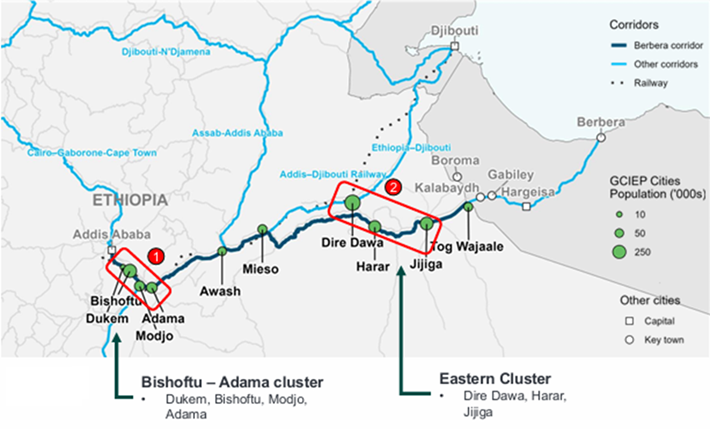
Connecting secondary cities along the Addis–Tog Wajaale Corridor in Ethiopia.
Preparing Dire Dawa for investment
To support this transformation, the Green Cities, Infrastructure and Energy Programme (GCIEP) is launching the Dire Dawa freight and transit-oriented development market sounding and investment preparation Initiative.
Running from March to June 2026, this initiative will identify, assess and prepare two to three investment-ready freight and logistics opportunities for presentation to leading development finance institutions and private capital providers, including the African Development Bank (AfDB), World Bank, European Union Global Gateway, British International Investment (BII), Private Infrastructure Development Group (PIDG) UK Export Finance (UKEF), and European Investment Bank (EIB). Opportunities will also be aligned with relevant financing windows of the Green Climate Fund (GCF).
The goal is clear: build a credible pipeline of projects capable of attracting international finance while supporting Ethiopia’s long-term economic development and climate ambitions.
A new model for urban logistics development
This initiative is centred on friend and transit-oriented development. A catalytic urban development approach that goes beyond traditional models of isolated logistics infrastructure. Instead, it integrates freight facilities with surrounding land use, commercial activity, distribution networks and industrial growth. By doing so, it creates economic ecosystems where logistics infrastructure actively drives productivity, trade and urban growth.
Dire Dawa’s unique combination of rail connectivity, industrial capacity, trade infrastructure and strategic location makes it particularly well-suited to this model
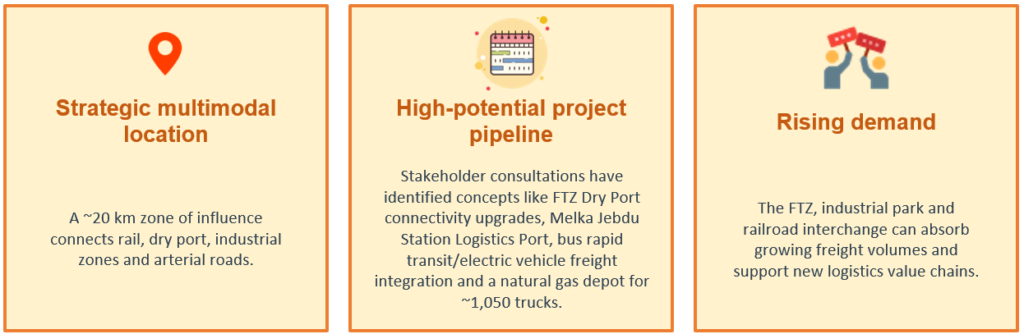
The potential for Dire Dawa to become a regional logistics hub.
Bridging the gap between potential and investment
Despite Dire Dawa's clear potential and advantages, several barriers continue to limit investment. and prevent projects from attracting development finance and private capital. Projects often lack detailed preparation, robust financial modelling and clear alignment with the requirements of development finance institutions and private investors.
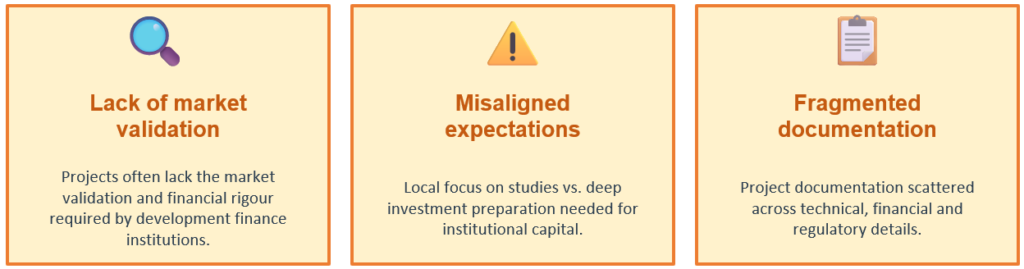
The challenges to overcome to attract investment.
This is where the market sounding process becomes critical. Through structured engagement with investors, public institutions and private-sector stakeholders, the initiative will test market interest, refine project concepts and strengthen the evidence base needed to move from concept to bankable investment.
From local opportunity to regional impact
This market-sounding initiative will position Dire Dawa as Ethiopia's most investment-ready secondary city for logistics and freight infrastructure, capable of attracting substantial capital to logistics, industrial, mobility and climate-resilient development.
A stronger pipeline of bankable projects would help unlock capital for logistics hubs, industrial infrastructure, mobility improvements and climate-resilient urban development. In turn, this would strengthen economic integration along the Eastern Economic Corridor and support Ethiopia’s broader development ambitions.
Importantly, the Dire Dawa model will serve as a replicable blueprint demonstrating how strategic urban development, investor confidence and institutional finance can work together to unlock sustainable growth in secondary cities across Ethiopia and the broader Horn of Africa region.
The transformation of Dire Dawa into a regional logistics hub would not only reshape the city’s economic future. It could also demonstrate the powerful role that well-connected secondary cities can play in driving sustainable growth across the region.
The UK’s Green Cities, Infrastructure and Energy Programme is tackling climate change and extreme poverty by accelerating the delivery of sustainable green cities and climate-resilient infrastructure.
Published
24/03/26