
- A post-COP30 action plan is guiding the operationalisation of Mozambique’s climate finance priorities.
- Exploratory engagement with international partners is helping identify feasible pathways for climate investment.
- Cooperation among the Community of Portuguese Language Countries (CPLP) emerged as a notable outcome, with the aim of continued technical exchange.
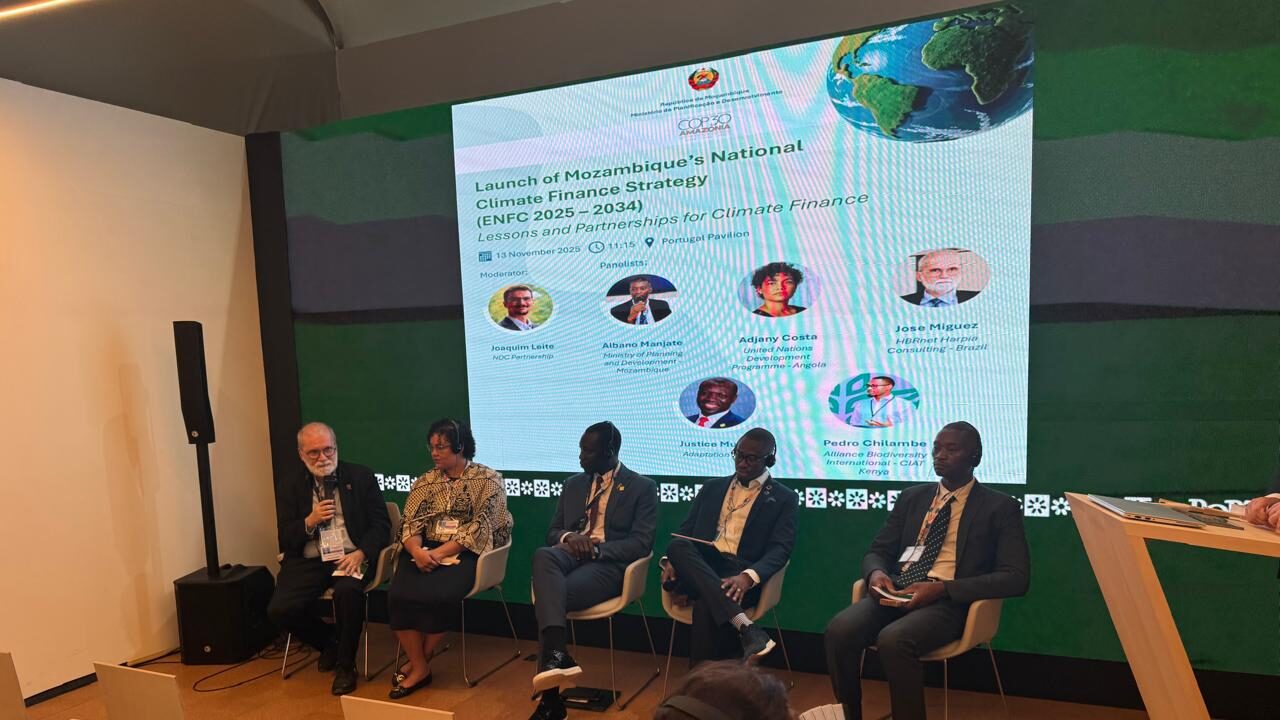
A session at COP30 encouraged dialogue and cooperation among African countries, development partners, private-sector actors and regional experts in climate finance.
Mozambique is moving from climate strategy to implementation, following the launch of its National Climate Finance Strategy at COP30 in Brazil.
The Strategy, developed in partnership with the Green Cities, Infrastructure and Energy Programme (GCIEP), marks a shift from policy formulation to delivery. In the months since COP30, the Government of Mozambique has begun advancing a structured action plan focused on strengthening governance, sequencing actions and creating realistic pathways to mobilise climate finance.
GCIEP is now working closely with the Ministry of Planning and Development to assess next steps emerging from discussions held during and after the summit. These engagements helped clarify potential opportunities across resilient infrastructure, renewable energy, climate finance mobilisation and carbon market readiness – identifying where further technical cooperation could add most value.
A notable outcome of COP30 was strengthened alignment within the Community of Portuguese Language Countries (CPLP). Discussions confirmed interest in advancing more structured cooperation on climate finance among Lusophone countries, building on shared institutional contexts and common challenges in accessing international climate finance. This provides a concrete platform for continued technical exchange and peer learning, positioning Mozambique as a reference point within the bloc.
As part of the post-COP30 action plan, GCIEP has facilitated initial exchanges with international actors to better understand available financial instruments, institutional models and lessons from other contexts. These discussions have helped assess the relevance of risk-mitigation tools and blended finance approaches for priority infrastructure investments.
South–South cooperation also emerged as a promising avenue. Technical exchanges with regional partners, like the Ghana Infrastructure Investment Fund (GIIF), highlighted opportunities for peer learning around climate-aligned financial mechanisms, offering insights that could inform Mozambique’s own investment structuring approach.
Energy remains a strategic priority, particularly renewable generation and regional interconnections. Engagements underscored the importance of continued dialogue on regulatory reform, investor risk mitigation and financing structures to support long-term initiatives such as regional power interconnectors.
Natural capital and carbon markets featured prominently in COP30 discussions. Initial technical exchanges with Pew Charitable Trusts on blue carbon, including seagrass mapping and ecological baselines, pointed to opportunities to strengthen national climate frameworks and support integration into Nationally Determined Contributions. In parallel, discussions on Article 6 (which enables carbon credits generated to be sold internationally) highlighted the need to further clarify institutional roles, authorisation processes and registry systems to ensure transparency and alignment with international guidance.
Beyond finance, water and resilience were identified as areas for deeper cooperation. Exploratory discussions with European partners helped identify potential entry points for future collaboration on transformational water-sector investments, subject to further scoping and alignment.
Overall, COP30 served as a catalyst rather than a conclusion. The post-COP30 phase is focused on consolidating lessons learned, prioritising opportunities and sequencing next steps, gradually moving from policy ambition to implementable climate investments that support Mozambique’s long-term resilience and development objectives, as underscored by President Daniel Chapo during the strategy’s launch.
The UK’s Green Cities, Infrastructure and Energy Programme is tackling climate change and extreme poverty by accelerating the delivery of sustainable green cities and climate-resilient infrastructure.
Published
09/02/26