- A vital water distribution project in Wa, Ghana has received a £12m grant following an investment case and feasibility study delivered by GCIEP.
- This initial phase of investment will deliver clean piped water to 5,000 households that are currently not connected to the network.
- The investment was formalised through a memorandum of understanding (MoU) signed by the Embassy of Denmark in Ghana and the Government of Ghana on 26 November.
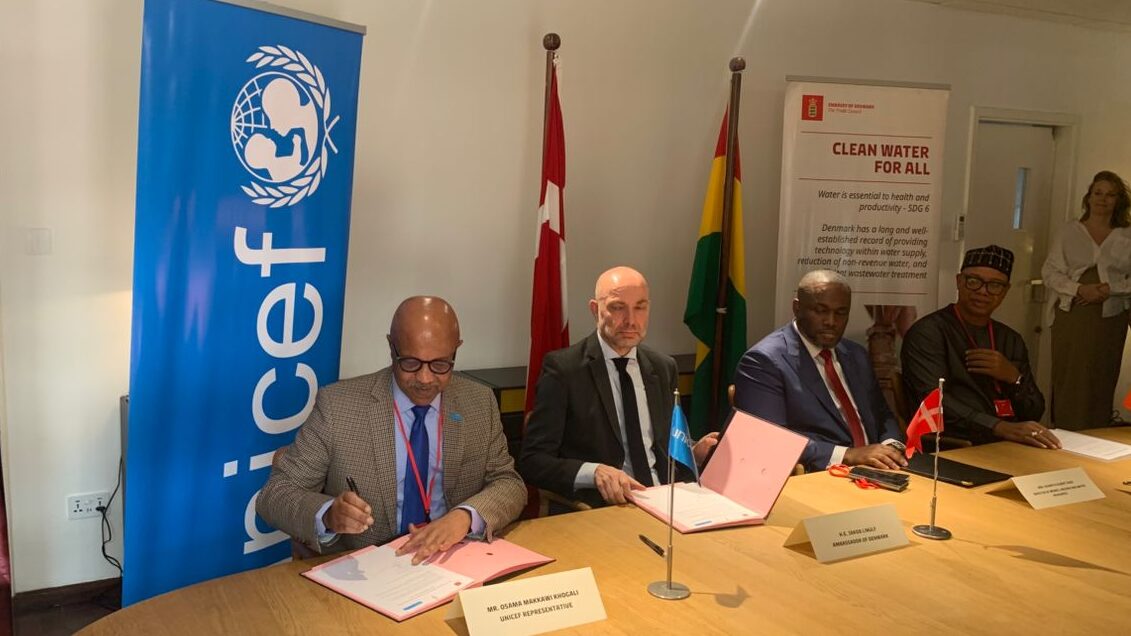
Representatives from the governments of Ghana and Denmark alongside UNICEF gather to sign a milestone agreement
An investment of £12 million has been secured to fund the first phase of the Wa Water Distribution Expansion Project, following a feasibility study delivered by the Green Cities, Infrastructure and Energy Programme (GCIEP).
It marks a major step towards closing the water access gap in northern Ghana by delivering clean piped water to 5,000 households that are currently not connected to the network.
A memorandum of understanding (MoU) formalising the investment and collaboration was signed at a high-level ceremony attended by the Minister for Works and Housing and Water Resources, Kenneth Gilbert Adjei; the Danish Ambassador to Ghana, Jakob Linuff; the Acting CEO for Ghana Water Limited (GWL), Adam Mutawakilu; and the UNICEF Representative in Ghana, Osama Makkawi Khogali. Representing the UK-funded support were FCDO Development Director, Terri Sarch, and the GCIEP Ghana Country Lead, Sheila Odoteye.
While the £12 million is provided by Denmark (DANIDA), the technical foundation for this investment was laid by GCIEP – collaborating closely with GWL to deliver a comprehensive feasibility study and investment case. This technical assistance was critical in converting the city’s infrastructure needs into a bankable project ready for international finance. The study provided the rigorous data needed to secure the investment, including technical network assessments, climate risk analyses and designs for expansion.
The project addresses a critical infrastructure deficit in Wa, a rapidly growing secondary city where water demand has outstripped the existing network's capacity. While the city already possesses a functioning water treatment plant, it currently operates at only 40% capacity because the existing pipe network is too limited to reach growing neighbourhoods. The project specifically targets that distribution bottleneck – expanding the network to finally utilise the plant's full potential and deliver the clean water that is already being produced but cannot reach the homes that need it.
This initial phase of investment is set to connect over 5,000 households to the piped water network. By replacing reliance on unsafe or distant water sources with direct home connections, the project is expected to deliver significant social benefits – particularly for women and girls, who often bear the burden of water collection.
Beyond this immediate funding, the full technical solution designed by GCIEP outlines a roadmap to eventually provide resilient water access to over 170,000 residents by 2034, demonstrating the long-term value of high-quality project preparation.
The UK’s Green Cities, Infrastructure and Energy Programme is tackling climate change and extreme poverty by accelerating the delivery of sustainable green cities and climate-resilient infrastructure.
Published
23/12/25